18 days in Fiji (# 4) Snorkeling, sea creatures and sea lice

Bula! Hello! We've just spent 18 days in Fiji. And what a time that was!

Before we went though I had so many questions! Well, now that we're home and I've found the answers to some of those questions, I thought I might share my discoveries. After all, sharing is caring. 

Also, I thought that by sharing my discoveries, I might help you save time, money and perhaps add to your safety and comfort!

So, over a series of posts, I hope to tackle some topics that might be of interest to you to help you in your preparation for a holiday in Fiji.


Picture perfect 
(Photo taken by and copyright Maria Ngo)


So here's the next topic I'm going to tackle - safety in the water - you never know what could be lurking there - and especially sea lice!  


Snorkeling, sea creatures and safety

Fiji is synonymous with coral reefs, white sandy beaches and crystal clear waters. With more than 300 islands, it makes sense that it is positioned as a preferred tourist destination for diving and snorkelling. 

When it comes to snorkelling it pays to keep your hands to yourself where coral is concerned. Firstly, coral are easily damaged. 

Secondly, because it can take a whole year for coral to grow up to 0.3 to 2 cm while some faster branching coral can grow up to 10 cm a year and your touch could set them back years. 

Thirdly, and more importantly, you might get stung - by pretty coral, cute fishes and also cleverly disguised fishes masquerading as dead coral or stone. 

Some coral can pack a nasty sting. I won't repeat what has already been well documented about stinging fire coral, black and white banded sea snakes, stone fish, lion fish, scorpion fish, moray eel, cone fish, jelly fish, crown of thorns, trigger fish, sharks, sea urchins, stingrays, rabbit fish etc. which you can read here and here

There was one little nuisance marine creature that appears to be undetectable to the eye that I want to talk about instead - sea lice! 


Sea lice 

We were so excited about finally getting to do some snorkelling at the smaller islands that we'd heard so much about when I felt little stings first on my finger and then on my arm. 

The sting did not last long and there was no immediate reaction like itching of the stung spot or rash or swelling or redness. The sting was intense but didn't last any more than a second or so and then it was gone. Or so it seemed. 

I carried on snorkelling and thought nothing of it. I couldn't see anything in the water and I was too engrossed in the coral and fish to give these a second thought. Every now and then I'd seem to "run into" a patch of warm water and experience more stings. By about the third or fourth "run ins" I was trying to make myself as small as possible and to present as few exposed body parts as possible. 

Lucky for me I had on an extra layer of tight fitting short sleeved rash guard suit and swimming shorts. This was in case I got cold in the water and also to reduce the amount of sunscreen I would normally use. 

It wasn't until the following day that the effects of these multiple stings added up to over 70 little itchy red bumps! 
And then a few days later, these little bumps became blistery looking bumps that made me look like I was diseased and had chicken pox or something! And the ITCH! It was dreadful! 

I had seven little bumps just on my thumb alone! Some of these were very close together and kinda "joined" up into one another. 


Itchy bumpy and blistery! 
(Photo taken by and copyright Maria Ngo) 

I found that ice helped sooth the itch. Also, luckily for me I usually travel with some sort of anti-septic anti-itching creams (usually something that contains a good amount of lignocaine in its active ingredient). I pretty much plastered myself with these. 

As the bumps looked like tiny little blisters, I took great care not to burst the blister and took care to avoid scratching them. 

Apart from the intense itchiness, I suffered no other ill effects like nausea, fever or vomiting which I was watching out for in case it was more serious. 

I did not yet know what these were until I went on another day cruise and chatted with the locals. I also searched the internet and found only one mention of something about sea lice but it sounded more like they were having issue with fleas rather than sea lice. 

My son's arm the day after encountering the sea lice
(Photo taken by and copyright Maria Ngo)

What the locals said was that Yes, there are things they called sea lice which they would encounter on occasion when they went into the sea. It was just something they were used to and it didn't seem to bother them. I surmised then that each person could potentially react differently to it. 

Some said that it was when the waters were warm that they noticed it most while others said that it was when the waters were rough and stormy. No one knew for sure what the optimum conditions were for these sea lice. They also did notice that they appeared in swarms. 

As for us, we encountered these at most places we went to on our day cruises, and hardly any when we were on Mantaray Island (on Nanuya Balavu Island in the Yasawa Islands group). 

And so began my search to find some means of protection against pesky stingers. 

So we went into Nadi town centre to look for rash vests and pants. 


The outcome wasn’t perfect, and with hindsight, I should have gone for a more fitting rash vest but the pants worked fine. 

Rash suits, ice, anti-itch creams and dilo oil 

So what have I learnt from all these? Wear tight fitting rash suits and pants as a guard against these sea lice. Ice the stings, apply anti-septic anti-itching creams. And one other thing, while chatting with one of the sales staff at Jacks of Fiji, I mentioned my encounters with the sea lice and she suggested a bottle of dilo oil. And the verdict? It seemed to work for me while another local said they used coconut oil for the stings. 


Dilo oil 
(Photo taken by and copyright Maria Ngo)


Anyway, forewarned is forearmed. Now you can be more prepared than we were. 

Vinaka vaka levu! Thank you very much for reading! Catch you at my next post. 


*If you've found this post helpful, click like, share it and do follow me.


18 days in Fiji (# 3) The resort lifestyle

Bula! Hello! We've just spent 18 days in Fiji. And what a time that was!

Before we went though I had so many questions! Well, now that we're home and I've found the answers to some of those questions, I thought I might share my discoveries. After all, sharing is caring.

Also, I thought that by sharing my discoveries, I might help you save time, money and perhaps add to your safety and comfort!

So, over a series of posts, I hope to tackle some topics that might be of interest to you to help you in your preparation for a holiday in Fiji.

Under a clear blue sky 
(Photo taken by and copyright Maria Ngo)


So here's the third question I'm going to tackle today - what's it like at a resort? 

The Resort Lifestyle 


I had a particular image of what a resort lifestyle was like before I arrived in Fiji. Here on Denarau Island, I found my expectations were more than met - in fact, they were exceeded. 

What I had imagined: beautiful views, relaxed atmosphere, friendly cheerful staff, good food, lounging by the pool side, manicured gardens, clean and well maintained facilities and safety. They were tick, tick, tick and more ticks. 

Let's take a quick tour around one of these resorts. 

Wyndham Resort (Photo taken by and copyright Maria Ngo) 

If you were to take a look on Google Maps to get your bearing, you'll notice that the resorts are on the western side of the largest island (Viti Levu) of Fiji. 


This means that you are well positioned for beautiful sunset views from the beach at these resorts.

There is a narrow strip of a beach linking these resorts - provided you can find your way down there - at high tide, this might not always be possible at all the resorts.

Out on the pontoon(Photo taken by and copyright) 


This strip of beach along here is not the nicest beach to swim in. In fact, I'd recommend you stick to the pool. You can check out the various sizes of the pools at each of these resorts quite easily on Google Maps in Satellite Imagery mode. But if water sports is your thing, you're in luck because the resorts offer a mixture of free and paid equipment e.g. kayaking, paddle boards, jet skis and even tandem parasailing. Not all resorts offer the same activities though. 


The pool all to ourselves 
(Photo taken by and copyright Maria Ngo)
Ball game for all ages 
(Photo taken by and copyright Maria Ngo)
What would lounging by the pool-side be without a suitably decorated drink right? I found that the mocktails hit just the right spot for me. There were quite a few to choose from and we were there for more than a week. Need I say more?

I'll have one of those please 
(Photo taken by and copyright Maria Ngo)

There was a good selection of cold and hot foods to choose from for lunch. The prices were in the FJ$30 mark. Dinners were slightly more. And oh, mocktails, were around the FJ$15 mark. 

A refreshing salad for lunch(Photo taken by and copyright Maria Ngo)
So many choices, what shall I order? 
(Photo taken by and copyright Maria Ngo)

Pulled pork burger 
(Photo taken by and copyright Maria Ngo)
Where we stayed, the rooms were beautifully presented and generous in size. We had an apartment with a balcony.

Master bedroom 
(Photo taken by and copyright Maria Ngo)

The second bedroom 
(Photo taken by and copyright Maria Ngo)

Included toiletries 
(Photo taken by and copyright Maria Ngo)

Balcony and view 
(Photo taken by and copyright Maria Ngo)

There were several clusters of ripe berries growing on a palm outside my bedroom window and I was able to watch the local birds up close while they carried on rather animatedly with one another as they fed on the berries.

Someone is having fresh berries for lunch
(Photo taken by and copyright Maria Ngo)

Can you spot the frog in this picture? (Photo taken by and copyright Maria Ngo) 
I saw quite a number of frogs one night as we walked back to our apartment after dinner one evening. They were larger than golf balls but smaller than tennis balls.
I wished my garden looked like that 
(Photo taken by and copyright Maria Ngo)

Summer is the rainy season in Fiji. This is from November through to April. On a number of days that we were there, it poured quite heavily at around 4 pm but cleared up just before dinner time. December is reported to have the most daily sunshine hours. March gets the most rain while January is the hottest month in Suva with an average temperature of  26°C (79°F). 

An overcast day by the pool
(Photo taken by and copyright Maria Ngo)

The resort has organised activities for adults and children throughout our stay. Most of these are free activities.

Activities board
(Photo taken by and copyright Maria Ngo)

There were Fijian language classes, coconut demonstrations, tie-dying, body board races, pool side bingo, medicine walks and more. A medicine walk is a guided walk which incorporates various commonly available plants right at the resort and their various medicinal properties and uses.

This resort has child minding and there is plenty to keep the little tykes occupied. 

Coconut demonstration - all the wonderful things you can do with the coconut palm 
(Photo taken by and copyright Maria Ngo)

Removing the coconut from its nut 
(Photo taken by and copyright Maria Ngo) 

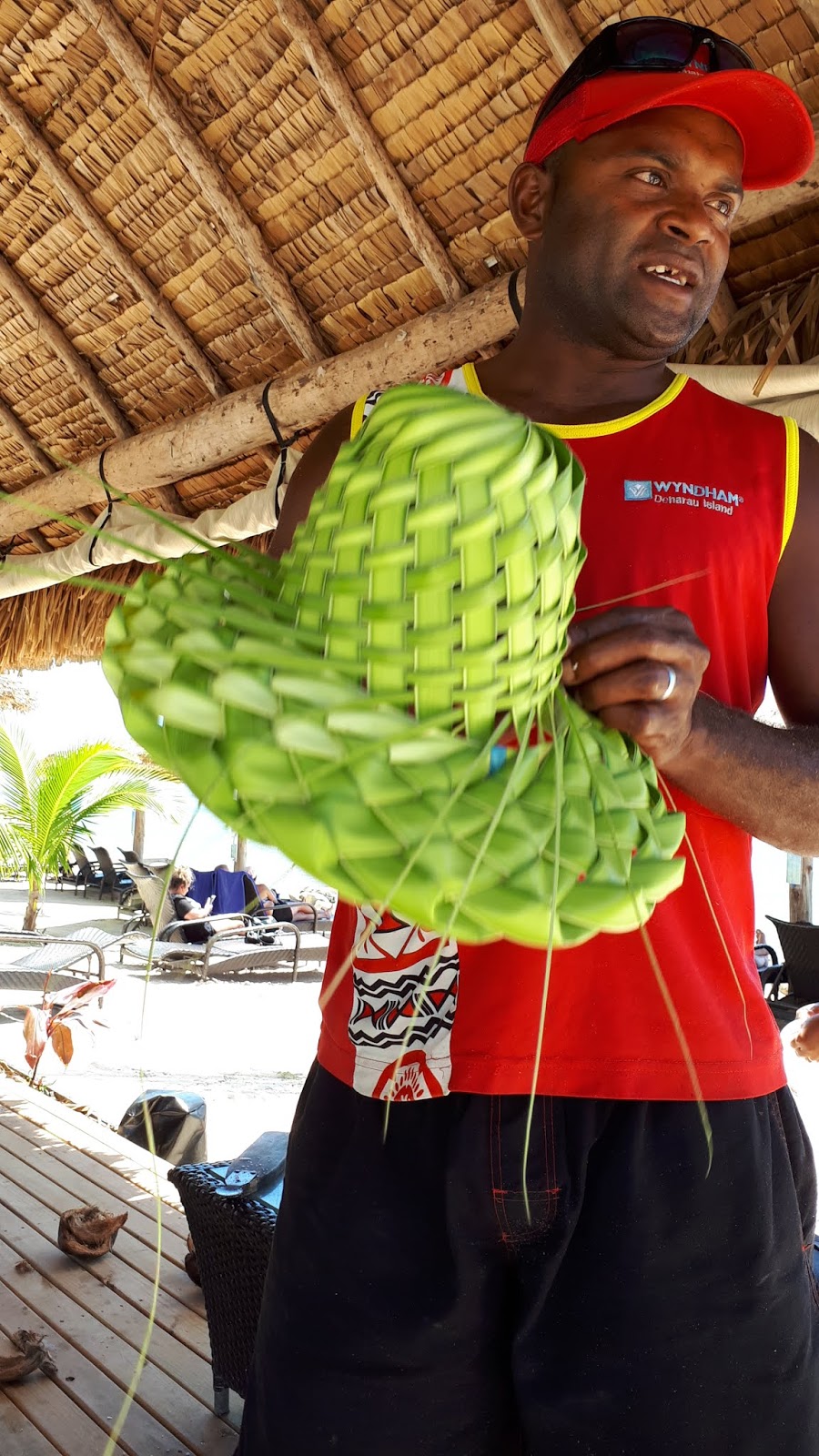
You can make hats from the coconut fronds 
(Photo taken by and copyright Maria Ngo) 
With my Fijian language instructor 
(Photo taken by and copyright Maria Ngo) 

A medicine walk
(Photo taken by and copyright Maria Ngo) 
A noni fruit 
(Photo taken by and copyright Maria Ngo) 
A well equipped playground will keep the little ones occupied.

Playground 
(Photo taken by and copyright Maria Ngo) 
Singing is a big part of the Fijian culture. When we arrived at the resort, we were welcomed with singing and an icy cold fruit punch. On several nights in the week, a group of singers would serenade hotel guests as they make their way around the resort. 

The serenaders 
(Photo taken by and copyright Maria Ngo) 
A serenade in the garden
(Photo taken by and copyright Maria Ngo) 
Down by the boardwalk
(Photo taken by and copyright Maria Ngo) 
If you fancy a spa or massage, you don't have to look far. 

A complimentary foot massage? Yes, please.
(Photo taken by and copyright Maria Ngo)

The resort has two restaurants. Mamacita and the Beach Shack Bar & Grill.

The Mamacita - exterior view 
(Photo taken by and copyright Maria Ngo) 


Mamacita menu 
(Photo taken by and copyright Maria Ngo) 
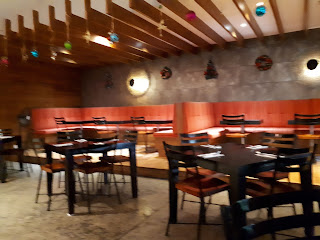
Inside the Mamacita
 (Photo taken by and copyright Maria Ngo) 

Another mocktail 
(Photo taken by and copyright Maria Ngo) 

History adorns the walls 
(Photo taken by and copyright Maria Ngo) 

Fancy a pizza for dinner? 
(Photo taken by and copyright Maria Ngo) 

Pasta 
(Photo taken by and copyright Maria Ngo) 

Vietnamese inspired dish
(Photo taken by and copyright Maria Ngo) 

Twice weekly entertainment at the Mamacita 
(Photo taken by and copyright Maria Ngo) 
The outdoor tables are the more popular ones. It pays to book ahead especially on performance nights.  

I was too busy enjoying my food at the Beach Shack Bar & Grill and forgot to take more photos (!). We were fortunate to get an ocean view table on our first night. It was the perfect finish to a perfect day.
At the Beach Shack Bar & Grill 
(Photo copyright Maria Ngo) 
Beautiful fresh seafood 
(Photo taken by and copyright Maria Ngo) 

If you prefer a restaurant at one of the other resorts but don't fancy walking, you can buy a ticket for a hop on and off inter resort island bus. 
Denarau Island Inter Resort Bus 
(Photo taken by and copyright Maria Ngo)
There is an ATM on site. Cash withdrawals attract a transaction fee of FJ$15 per transaction.
ATM at Wyndham 
(Photo taken by and copyright Maria Ngo) 
A basic grocery store serves the guests. If you prefer, there is a larger one at the Sheraton resort a short distance away. These supermarkets are much dearer than Australian ones but the one at the Sheraton offers slightly better prices. If you have the time, I suggest stocking up at a supermarket in Nadi town (see my other post on how to get there). As you can imagine, the resort lifestyle has its associated costs. 

Grocery at Wyndham 
(Photo taken by and copyright Maria Ngo) 
Sunset on Wyndham 
(Photo taken by and copyright Maria Ngo) 

Hope you've enjoyed your tour of one of the resorts on Denarau Island.

Vinaka vaka levu! Thank you very much for visiting with me. Hope you'll join me for my next post. 

Can you picture yourself there? 
(Photo taken by and copyright Maria Ngo) 


Search This Blog