18 days in Fiji (#10) Cruising with Captain Cook, PJ's Sailing and South Sea Island cruises

Bula! Hello! Thanks for joining me on another instalment on day cruises departing from around Port Denarau in Fiji.
A colourful energetic Fijian meke (Photo taken by and copyright Maria Ngo) 

As mentioned previously, we went on 5 day cruises of which 3 had very similar themes. This post is going to be about these three.

I hope that you'll find the information here helpful for making wise vacation plans that will maximise your enjoyment and give you the best value for your money.
Historically the Fijians were warriors (Photo taken by and copyright Maria Ngo) 

Captain Cook Cruises 

Captain Cook Cruises picked us up from our hotel in a very comfortable coach promptly at the indicated time.

We didn't have to wait too long to be directed to the pier for boarding a sleek modern catamaran. It was clean and well maintained.

We were greeted by a group of friendly staff who later entertained us with local songs. Even their safety information presentation was entertaining.

Welcome to Captain Cook Cruises 
(Photo taken by and copyright Maria Ngo) 

The journey to Vitua Island took just over an hour.

I can see the island 
(Photo taken by and copyright Maria Ngo) 

Vitua Island is quite picturesque from the sea with its beautiful white sandy beach. When we arrived, their other vessel, a tall ship, was already moored there.

Tivua Island 
(Photo taken by and copyright Maria Ngo) 

The island itself is not very large and you can quite comfortably walk all around it in less than an hour.

On the sandy beaches of Tivua Island 
(Photo taken by and copyright Maria Ngo) 
There are beanbags, chairs and coconut palm leaves shelters dotted on one side of the island. There are also low growing trees that provide further shade.

We brought our own snorkels and masks so did not need to borrow theirs. There are canoes, paddle boards and a glass bottom boat tour that you can participate in.

Although the island is supposedly surrounded by majestic coral reefs, as we were encouraged not to go out too far, we did not actually encounter them in their full glory. We also didn't see the medicine nature walk, nor learn to husk or weave coconut fibres or participate in a traditional kava ceremony mentioned on their website. In spite of that, it was a relaxing day. 

First, the sun screen 
(Photo taken by and copyright Maria Ngo) 

Buffet lunch was served in the main 'hut'. There is quite a selection of food including vegetables, meat and fish to choose from. Beer, wine and soft drinks were included with the meals along with fruit. Unfortunately, what we wanted more than any sweetened drinks was just cold water.

There isn't a 'gong' or bell to alert you to when the meal is served unfortunately. We were too busy swimming on the far side and lunch was well underway when we arrived at the indicated time.


Ahh, coconut
(Photo taken by and copyright Maria Ngo) 
There are no proper showers on this island except for a number of open shower heads installed right near the jetty which I came across rather by accident. It took me just a moment to decide for a very quick rinse before boarding our vessel - even though I was trailing last. The others in my party had not even noticed the showers...

As we were to arrive back in port by 5 pm, it didn't feel like we had had much time on the island. But, that was fairly typical of the day cruises we went on with the exception of the South Sea Island full day cruise as it was only 30 minutes away by fast speed catamaran.

Cruising in the rain
 (Photo taken by and copyright Maria Ngo) 

Similar to most days we were there, it being December, while the day could start out beautiful with blue skies and narry a cloud, it started raining and storming about late afternoon. The cheerful well trained crew brought us all safely back to shore by which time the rain had subsided.

PJ's Sailing Adventures 

Another cruise that we'd booked prior to arrival in Fiji was PJ's Sailing Adventures.

This group is pitched as a boutique sailing operation with high emphasis on fun and plenty of activities. In this respect, it was quite accurate.

PJ's Sailing Adventures
 (Photo taken by and copyright Maria Ngo) 
We were greatly impressed by the musical abilities of the threesome who entertained us with their wide ranging repertoire of songs once we arrived at the island as well as on the trip back.

A mesmerising performance 
(Photo taken by and copyright Maria Ngo) 

Philip who played the guitar magnetised us with his voice and did what the pipe piper did with his flute, only he did it with his singing. Tom was unbridled talent making do with an old plastic bucket and worn out snorkelling tube for drums. Ken played the ukelele and made the performance complete.

It took us nearly an hour and a half sail out to Serenity Island. This island used to be called Bounty Island until recently when it was sold to its current American owner. (The island is still named Bounty Island on Google Maps however.)

The crew handed out drinks and fruit both on the way out and back. They even did a weaving demonstration on the return trip.

This is nice! 
(Photo taken by and copyright Maria Ngo) 

The boat can take a maximum of 29 passengers. As far as seating went, we sat where we could find space on the open deck. I was glad to have my sunscreen, hat and sarong handy to provide further shade to what the sail offered.There are only thin metal guard rails around the vessel, so if you have wandering toddlers, I would recommend a toddler 'leash' and staying in the enclosed covered area near the rear of the boat.
The cheerful crew 
(Photo taken by and copyright Maria Ngo) 

Upon arrival we were greeted with a refreshing fruit punch. Shortly after that we were instructed on the procedure for our snorkelling excursion. This was a well 'chaperoned' snorkelling excursion and we were able to experience what the coral reef had to offer. We were however not prepared for the sea lice that were present in the tropical waters at the time of year which somewhat marred our snorkelling experience. You can read about how you can prepare for such eventualities in one of my earlier posts.

Oops! I meant to take a photo of it earlier
 (Photo taken by and copyright Maria) 

Those who prefer a more controlled environment than the sea can swim in the pool or relax on deck chairs around the well proportioned decked area.

Which will you choose? The pool or the deck chair 
(Photo taken by and copyright Maria Ngo) 
Ocean view by the pool 
(Photo taken by and copyright Maria Ngo)


The built up area is quite extensive and impressive. The restaurant area was very comfortable and reflected a true resort experience as it also caters for overnight guests. The shower block was in keeping with the rest of the place.
The meals area 
(Photo taken by and copyright Maria Ngo) 
The meals area 
(Photo taken by and copyright Maria Ngo) 
The meandering boardwalk paths connected with manicured lawns, carefully tended frangipanis, sheltered gathering spaces and the Hawksbill Turtle sanctuary area. It appeared to cater for a more upmarket clientele than your run of the mill backpacker and was relaxed and very comfortable.

Meandering paths and sheltered spaces for groups big and small 
(Photo taken by and copyright Maria Ngo) 

Hawksbill turtle 
(Photo taken by and copyright Maria Ngo) 

More about the Hawksbill Turtle 
(Photo taken by and copyright Maria Ngo) 

This was one island where departing was difficult for me - partly also because of the short time we were able to stay on the island. Yet within the short time allocated, we had a very leisurely lunch with a main, dessert, drink as well as tea/coffee. This was no buffet style lunch and it included table service.

Lunch 
(Photo taken by and copyright Maria Ngo) 

Dessert 
(Photo taken by and copyright Maria Ngo) 

After lunch we attended a talk about the coconut palm. It is truly the tree of life as every part of the palm and fruit is useful for food, shelter and other practical uses (notice the 'sieve' in the photo below). We also tasted pure coconut milk from freshly grated coconut.

It doesn't get any fresher than this 
(Photo copyright Maria Ngo) 
The crew were friendly, attentive and went above and beyond what one might expect from a day cruise. My only regret was that I did not have my wallet with me to add to their staff appreciation fund because they more than deserved it.

Someone should sign them up
 (Photo taken by and copyright Maria Ngo) 

South Sea Cruises 

As with the other cruises, we took the full day package offered by South Sea Cruises. Each cruise company appear to have their own particular island that they bring day trippers to and which they are responsible for. 

A bula welcome
 (Photo taken by and copyright Maria Ngo) 
South Sea Island was only half an hour away by catamaran and gave us plenty of time to enjoy its amenities. As the cruise company offered other packages, we saw other groups join us on the island to participate in the snorkelling or glass bottom boat activities and lunch - they arrived and left as scheduled. 


Paddle boards, kayaks and other non-motorised equipment for your use 
(Photo taken by and copyright Maria Ngo) 
Glass bottom boat 
(Photo taken by and copyright Maria Ngo) 


They were able to differentiate the different groups by their different coloured wrist bands. On the whole, it was a well run operation - staff on land and on board were professional, helpful and friendly. 


Welcome 
(Photo taken by and copyright Maria Ngo) 
There is a dive shop on the island as well for those who might like to have a go at diving. They offered introductory classes as well as advanced. 

Dive shop 
(Photo taken by and copyright Maria Ngo) 

You can snorkel directly off the island from the beach or you can take one of their boats that take you further out to deeper water to have a go at feeding the fish.
Hello hermit crab
(Photo taken by and copyright Maria Ngo) 
The water was not crystal clear but we were able to see a variety of fish and coral here. It was not until we got to Mantaray Island (see my next post) however that I finally saw them as I had hoped.

Of the three islands that we visited in this comparison, South Sea Island offered the most seating areas and shade. There were mats, hammocks, bean bags and chairs scattered around the island and we were well catered for.

Plump beanbags 
(Photo taken by and copyright Maria Ngo) 

Hammocks a beckoning 
 (Photo taken by and copyright Maria Ngo) 

Shady palm trees 
(Photo taken by and copyright Maria Ngo) 

Sun lovers and shade seekers
 (Photo taken by and copyright Maria Ngo) 

I met a lady who didn't even go into the water but was happy to enjoy the relaxed atmosphere of the island on her day off with narry a care and with unlimited supply of soft drinks, bottled water, tea/coffee and an extensive buffet lunch.


Lunch 
(Photo taken by and copyright Maria Ngo) 

Self-service tea and coffee
 (Photo taken by and copyright Maria Ngo) 
There was a lengthy traditional Fijian performance at the two buffet lunch sittings. I was not expecting such a cultural performance so we were not seated to take advantage of the performance as well as partake of lunch. We had chosen our spot for its proximity to hammocks and plenty of shade.

Traditional Fijian dance harking back to more warlike times 
(Photo taken by and copyright Maria Ngo) 

There was a small pool on the island which I felt was built for a smaller number of guests than we had that day.
An alternative to the sea
 (Photo taken by and copyright Maria Ngo) 
If you have little ones with you, this cruise comes with whole day child minding in the centre of the island under a rotunda. Massages are available but not included in the cost.


A relaxing massage 
(Photo taken by and copyright Maria Ngo) 

This small island does not have its own water supply. All water is brought to the island and at the end of the day, we saw the rubbish bins being emptied and taken away to be disposed off elsewhere.

There is accommodation for overnight guests and shower facilities is very basic.

As the distance between the island and Denarau Marina is only half an hour, we found that this cruise offered us the most time on the actual island.

My island princess 
(Photo taken by and copyright Maria Ngo) 


Conclusion 

So in summary, while most cruises offer some sort of meal/drinks package, I found that it would have been helpful for me to have known in advance if drinks included plain water. If not, I'd have brought my own supply. Being a borderline diabetic means that I have to be conscious of my sugar consumption and soft drinks isn't on my list of prefered fluids especially when I've been out in the sun enjoying water sports.

Free flowing soft drinks 
(Photo taken by and copyright Maria Ngo) 

Weather is another factor to consider. It can get rather wet during the Australian summer holidays (Dec-Jan) in Fiji on the west coast (around Nadi) with tropical thunderstorms forecast for the mid to late afternoon most days. We were there for 18 days from early December onwards but we encountered pretty good weather most of the time we were there. The downpours typically lasted just a few hours and then cleared up. Only on a few days did the heavy clouds hang around during the daytime.

Sailing 
(Photo taken by and copyright Maria Ngo) 
We booked most of our tours a few months before our departure. But if you wanted to do it in Fiji itself, you might be able to get more accurate weather forecasts the closer you are to your intended cruise days.

A Fijian meke 
(Photo taken by and copyright Maria Ngo) 

If I have young kids (babies, toddlers and older), knowing ahead of time the type of vessel, length of sea travel as well as whether child-minding was available on the island or not and whether my children are 'water babies', prone to sea-sickness or not would determine if I went on the cruise or not. As it turned out, one couple brought their few month old baby along on the South Sea Island cruise. They did dip into the water but they weren't into diving. Another family had 2 young primary/pre-primary aged kids and one of them became rather sea-sick on the return trip. The 1.5 hour return trip in windy conditions did tax my personal tolerance in spite of having taken motion-sickness tablet as a precaution. 

The youngest tourist 
(Photo taken by and copyright Maria Ngo) 
So, if time is short I hope this post will have given you a few more things to take into consideration when deciding on your cruise. But, if you have the time, by far the better way to experience the sea is to stay on the outer islands where the water is clearer and there is more coral and marine life to experience close to shore.

Washed up by the sea 
(Photo taken by and copyright Maria Ngo) 
Part of the problem with the day cruise islands is that with the large number of tourists using the islands, it is hard to police how they treat whatever coral might be growing close to shore. It takes but a moment to destroy unintentionally but years to grow.


A sea urchin test or outer skeleton which is made up of ten fused plates 
(Photo taken by and copyright Maria Ngo) 
On one island I saw metal cages on the sea floor that aided and protected growing coral. Coral need something to attach to to grow. It made me think of Jason de Caires Taylor's submerged sculpture series. Perhaps, someone reading this might encourage some local artist to contribute to the local marine ecology and advance Fijian tourism all at the same time (!). And if they do, just remember, you read about it first here (*wink*).


Every day is a holiday when you are having fun 
(Photo taken by and copyright Maria Ngo) 
So with that, I shall say Vinaka, thank you for reading. If you've found this post helpful, do like it, share it and follow me.

Time to put my feet up 
(Photo taken by and copyright Maria Ngo) 


P.S. After this series on Fiji, I have in the pipeline Western Australia, South Australia and Queensland over the next few months.


18 days in Fiji (#9) Cruising with Freewind Sailing Adventures

Bula! Hello and welcome to my series on Fiji.

Before my trip I had many questions. After 18 days in Fiji (with five day cruises and four nights on an island resort) I felt quite equipped to answer a few of these questions. So, here I am, sharing with you my discoveries in the hope that you will have a more enjoyable holiday and be able to make wise decisions that will help you make the most of your time there.
 So now, onwards and forwards to the topic of day cruises.

During those 18 days, we had the opportunity to go on five different day cruises which stopped off at four different islands plus one that we didn't actually land on. Three of these were quite similar, the fourth was almost like a private charter, while the fifth was little bit more 'action packed'.

So, today, I'll talk briefly about the 'private charter' day cruise.

Skipper Ron 
(Photo taken by and copyright Maria Ngo)

Cruising with Freewind Sailing Adventures 

The first day cruise we embarked on was with Freewind Sailing Adventures. This was a cruise we had pre-booked before leaving Australia. Like many other Fijian cruises with an online presence, booking any cruise is simple and straightforward.

Ron and Joyti are the entrepreneurial couple who operate this 46 foot sailing vessel that can take 15 people for day excursions or 4 for overnight or longer. They usually sail the waters of Savu Savu Bay but also do customised trips to suit their clients.

With Ron and Joyti 
(Photo taken by and copyright Maria Ngo) 

We met Ron near the jetty of Port Denarau. The Freewind is anchored a little off-shore from the jetty so we take a small dinghy to get on it. When we were all safely boarded, we set sail in a generally westwards direction towards Malolo Island after navigating through the port area.

Freewind 
(Photo taken by and copyright Maria Ngo) 
Charting a course for the island 
(Photo taken by and copyright Maria Ngo) 
We were served tea and biscuits while we enjoyed the sea breezes and looked forward to plunging into the waters of the Pacific Ocean. For this trip it was just us (a family of four) and a European traveller. We stopped short of the island and dropped anchor after slightly more than an hour of sailing.

In the cockpit 
(Photo taken by and copyright Maria Ngo) 
You can change below deck, but as I suffer from sea sickness quite badly, I make it a point to never go below deck or into confined spaces on a small boat - I have learnt my lesson the hard way. So I was already dressed in my swimming gear and it took no time at all to put on my snorkel.

Ready for the plunge 
(Photo taken by and copyright Maria Ngo) 

One by one we jumped into the water to explore the coral reef with its marine inhabitants. Perhaps my expectations had been set rather high by colourful images of Fijian waters and marine life, but, for comparison's sake, it wasn't anything like the Great Barrier Reef or Malaysia's Tioman Island (of years ago) but it wasn't bad either (that's the Aussie understatement at work here). I was also rather distracted by my first encounter with sea lice.

Nevertheless, the water was clear and the fish was plentiful and colourful. My son had a ball and you could not drag him back on board. That was one of the reasons we didn't make it to the island. As our focus was on snorkelling rather than kayaking or sun tanning on the beach, we didn't mind skipping that part of the trip.
Having a yarn on board with fellow passengers 
(Photo taken by and copyright Maria Ngo) 
Lunch was beautifully prepared by Joyti and comprised of a tasty meat and salad roll. This was later followed with home baked chocolate cake and more tea.

On the journey back, we encountered rain. It was after all December which is when you can expect tropical thunderstorms in the late afternoon, which after a heavy downpour, generally clears up for the evening. Just as well I was still in my swimming gear as there isn't much shelter if you want to stay in the cockpit. You can always go below deck if you want to stay perfectly dry. The five of us decided that we preferred the cockpit.

Sailing back into port 
(Photo taken by and copyright Maria Ngo)

View of Port Denarau from the boat 
(Photo taken by and copyright Maria Ngo) 
By the time we arrived back in Port Denarau, the weather had cleared. The Fijian Christmas trees are in bloom from November to January usually and put out a colourful display in the shopping mall.
Dining options in Port Denarau with Fijian Christmas Tree in the foreground 
(Photo taken by and copyright Maria Ngo) 

Dining in Port Denarau 

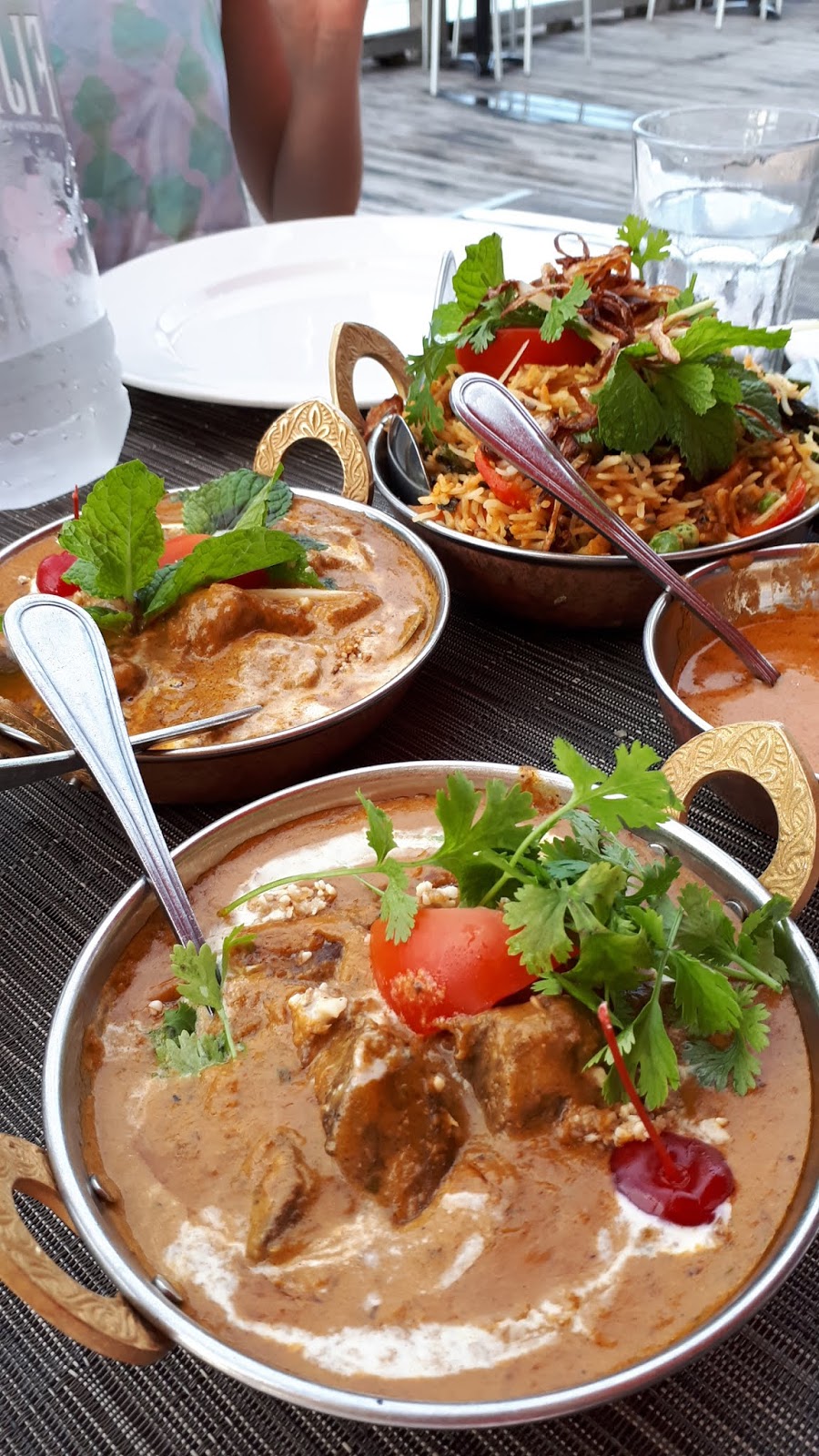
As it was already getting on in the day, we decided that dinner in Port Denarau would be a good option. After spraying on the prerequisite insect repellant for dining out in the evening by the waters, we check out the place. There is quite a selection to choose from. We decided in this instance to go Indian and also enjoy the water views.
Dining by the water 
(Photo taken by and copyright Maria Ngo) 
There was a free fire dancing and musical performance in the centre of the shopping mall while we were having dinner. We couldn't see the show from the restaurant so it was a case of catching what we could or letting the food get cold. We did a little bit of both (!).
Fire dancing 
(Photo taken by and copyright Maria Ngo)

If you are planning to do dinner in Port Denarau at this time of year and you also enjoy cultural performances, I'd suggest that you time it better than we did. The performance was of a decent length and well worth watching.

Dinner is served 
(Photo taken by and copyright Maria Ngo) 
Catching a taxi back to our resort was a simple matter. Even at that late hour, the taxis were still operating and at the taxi stand, we were directed to a waiting taxi by one of the friendly Fijians dressed in a similar garb to those we had seen earlier in the day manning the taxi area. We had no problems returning to Denarau Island for less than FJD10. For door to door service for four people, that was good value.
Someone said 'Taxi'? 
(Photo taken by and copyright Maria Ngo) 

We arrived back safely, tired, rain washed and quite satisfied with our day's adventures - the first of many more to come.

Fijian Christmas Tree 
(Photo taken by and copyright Maria Ngo) 

Vinaka and thank you for reading and staying with me on my Fijian adventures.

Hope you'll keep reading! If you liked this post, do click like and share it! Vinaka vaka levu!


18 days in Fiji (# 8) Swim or hitch hike to the islands?

Bula! Welcome to my 8th post on Fiji.

Before going to Fiji I had many questions for which I couldn't find answers easily. Well, upon my return I decided to share them with you in the hope that you might benefit from my discoveries and have a smoother more enjoyable holiday!

Yes, we put it right back after the photo
(Photo taken by copyright Maria Ngo) 

In this post today I want to tackle a question I had which was about how one gets from the resort to the various islands. For the best snorkelling and diving are found out there.

Welcome to Mantaray Island
(Photo taken by and copyright Maria Ngo) 
I had no idea how 'primitive' or 'advanced' the transportation network was before we arrived. In all honesty, I thought I'd be taking a small speed boat or a rickety 'ferry' of sorts to get from the mainland (on the west coast near Nadi) to where the action was. I was not looking forward to this aspect of the trip because I am by all accounts a horrible sea farer. I probably had this notion in mind in part due to my experience on Phi Phi Island,Thailand and Borocay, Philippines.

Beautiful coral and fish just a flipper kick away
(Photo taken by and copyright Maria Ngo) 
All I can say is that Fiji compared to those two places is like chalk and cheese. What I discovered and experienced in Fiji far exceeded my expectations. So in answer to your question, do you swim or 'hitch hike' to the islands, I'm glad to say, neither. 

One of the ways to get to the islands
(Photo taken by and copyright Maria Ngo)
In years past, this might have been almost the case when Fiji was mostly a back packer's destination and it was a challenge to get to the outer islands. But after the development of more up-market resort style accommodation (thanks to some enterprising Kiwis) on these islands took off, a consortium developed an efficient and cost effective means of moving people via fast speed catamaran.

On board the top deck of the Yasawa Flyer
(Photo taken by and copyright Maria Ngo) 
The Yasawa Flyer is a fully equipped modern vessel and offers an upper deck which has unhindered ocean views, a middle deck which has outdoor seating to the rear of the vessel and air-conditioned seating on comfortable seats towards the bow on the lower deck.

Departing the Yasawa Flyer for the island
(Photo taken by and copyright Maria Ngo) 
If you are travelling out to an island resort, the process of off-loading (and also on-loading) your luggage and yourself is a well refined process. Just follow the instructions as they are announced on the PA. If you have luggage, just before arriving at your destination you will be asked to identify your luggage on the lowest deck. After identifying your luggage, just wait on the bottom deck for further instructions.

Two boats from the resort will meet you at the Yasawa Flyer You don't have to physically lift any of your luggage onto the smaller craft. The staff will do that for you. (I was worried about having to do this myself before my trip! I was not sure how I was going to manage this being rather wobbly at sea.) One of the smaller crafts will be just for luggage while the other will take on passengers.

Smaller transfer crafts
(Photo taken by and copyright Maria Ngo) 

Mantaray Island welcoming party
(Photo taken by and copyright Maria Ngo) 

This is a well honed process and is undertaken with almost military precision with effective communication from the island to the vessel to time the meeting of the vessels perfectly and with the least amount of time wasted in transferring people and luggage.

No sweat - for me at least
(Photo taken by and copyright Maria Ngo) 
The Yasawa Flyer makes quite a number of stops to drop off and pick up passengers as it makes its circuit in a northerly direction from Port Denarau out to the furthest resort which is about 4 hours away. On its return trip it'll do the same at each resort or island.

Yasawa Flyer route
(Photo taken by and copyright Maria Ngo) 
There are other ways of getting to the islands that are closer to the main island. Smaller pleasure crafts that seat anywhere from 8 passengers to about 40 (as a guestimate) are not uncommon. If speed is of essence I recommend the Yasawa Flyer. But if you enjoy a more leisurely sailing experience, then opt for one of the other options.

Another day another cruise
(Photo taken by and copyright Maria Ngo) 

Onboard entertainment
(Photo taken by and copyright Maria Ngo) 


Not ABBA but they come close!
(Photo taken by and copyright Maria Ngo) 
We experienced both. Our first sailing experience was with an intimate small group of seven - five passengers (we, as a family of four), one other passenger and the two owner operators. We got home-made chocolate cake and tea for afternoon tea and a lovely sandwich lunch on our cruise with Freewind Sailing Adventures.
Captain of Freewind
(Photo taken by and copyright Maria Ngo) 

Freewind
(Photo taken by and copyright Maria Ngo) 

If you are taking the Yasawa Flyer, you might prefer to bring your own supplies. But you can also purchase snacks on board the vessel.

Tickets for your transfers from your hotel to Port Denarau can be purchased easily online or in person at the Passenger Terminal which is well organised and extremely clean - and I include the toilets in this assessment.
Passenger Terminal, Port Denarau
(Photo taken by and copyright Maria Ngo) 

Transfers from the hotel to the port are also well organised and systematic. They run a number of large comfortable, clean, modern coaches for the morning run to the port and vice versa in the evening.

Front seat view from the coach
(Photo taken by and copyright Maria Ngo) 

Did I mention that everyone speaks English? And the signs are in English also? If that's your language you'll be right.

So I hope that has answered your question on how to get from the mainland to the outer islands. In short, it's quite a breeze - as long as you book ahead. And with modern effective telecommunications infrastructure in place (which is even available in the villages) and just about every company having their own website, travelling has never been easier.

Have a great holiday!

Vinaka vaka levu for checking out my blog.

Sailing with the wind
(Photo taken by and copyright Maria Ngo) 

Click follow to not miss out on any of my posts!


18 days in Fiji (#7) Bula! Music, fire and welcome!

Bula! Hello and welcome! After spending 18 days in Fiji, a bit of it does rub off on you.

Frangipani 
(Photo taken by and copyright Maria Ngo) 

Thanks for popping by on my 7th post now on my series on Fiji. The aim of this series is to help you have a smoother more enjoyable holiday, be less stressed and make wiser decisions that could save you money and keep you safer. (For those who missed out on my post on marine dangers, you can check it out here.)

My post today is a brief introduction to some aspects of the Fijian language and culture that you can expect to encounter.

Music, fire and welcome! 

I'd been told that Fijians are a very friendly people. Well, I had no idea how friendly and welcoming they were because my very first encounter was a very pleasant surprise.

Right in the immigration customs hall in Nadi International Airport, even before I'd collected my luggage, we were greeted by a trio of singing Fijian men dressed in their sulu complete with white frangipanis behind their ears.

They were such a welcome sight and sound to my sleep deprived brain and body as we stepped off our 5 hour flight shortly after 6 a.m. that morning.

I was not sure if I was allowed to take photos, so, my apologies that this photo isn't the clearest one as I tried to take it surreptitiously. I tried not to stare but I could not take my eyes off this rather unusual welcome to the country. (Perhaps you'll take a better one and share it with me. *wink*) So right there and then was my introduction to the role that music played in their culture.

Welcome to Fiji! 
(Photo taken by and copyright Maria Ngo) 

I was to encounter their deep appreciation of music and the profound way in which it was used to capture their history and preserve it through role play and story-telling over and over and over again in the coming days.

Music was used to recount this people's journey from a land far away and their delight in a good catch of fish and even battles fought. There is even one about the boogey man and what happens to misbehaving children.

The guitar and ukele appear to be the main preferred instruments. I have no doubt that their transportability as well as tonal qualities that match the human voice so perfectly, have something to do with it.

Our first brush with the Fijian welcome was continued with more upon arrival at the resort we were staying in.

Wyndham serenade 
(Photo taken by and copyright Maria Ngo)

This was soon to become a key feature of the day cruises/trips and another resort where we stayed for 4 nights. (By the way, I will write a more detailed account of these in future posts, so keep coming back.)

The crew on board PJ's fishing, snorkeling and sailing adventures included some contemporary and other well loved country western and pop classics. The stringed instruments were accompanied by skillful drumming with a plastic bucket and worn out snorkel.

Musical soiree with PJ's Fiji fishing, snorkeling and sailing adventures
(Photo taken by and copyright Maria Ngo)
A musical Bula welcome! 
(Photo taken by and copyright Maria Ngo)

In Port Denarau, in the evening, we were treated to more free public performances with music and fire dancing. The fire dancing is in the central 'hub' of the shopping centre in Port Denarau while the restaurants tended to face the water. So you can't dine and watch the performances.

I was quite surprised at the length of this free musical performance and fire dancing. If I had known earlier about where the performance was going to take place, I would have timed our meal better to take advantage of this.

Dinner at Port Denarau 
(Photo taken by and copyright Maria Ngo)

Fire dancing 
(Photo taken by and copyright Maria Ngo)

Bula! Vinaka! 

Now, don't be taken aback if someone suddenly calls out loudly to you, 'Bula!' It's just a very enthusiastic Hello and/or Welcome!

Bula! is pronounced 'Mboo-lah!' although the 'm' is almost imperceptible, you could for all accounts get away with just saying 'Boo lah'.

This phrase is used morning, noon and night.

If you want to be more formal, you could say 'Ni sa yadra' (pronounced Nee sah yan drah) for Good Morning, and 'Ni sa Bula' (Nee sah mboo lah) for Good afternoon or Good evening. But generally, Bula covers just about every situation.

If you notice in the above, 'yadra', the 'd' is pronounced with an 'n' before it. Such that Nadi is actually pronounced as Nahn-dee. 

The letter 'a' is pronounced like in 'ah' rather than 'ay'.

Another phrase that you'll hear a lot of is Vinaka! (Vee naka). This means, Thank you.

Another opportunity to practice saying Vinaka 
(Photo taken by and copyright Maria Ngo)

And if you wanted to say, Thank you very much, you would say 'Vinaka vaka levu' (Vee naka vaka ley voo). 

There are lots of other phrases that you could learn (which have been well documented elsewhere), but, with a cheery Bula! and grateful Vinaka, you'll soon feel quite at home among the Fijians. This is because while you'll hear them conversing with one another in a Fijian dialect, if you speak English, you'll have no problems being understood. English is after all one of the three official languages spoken in Fiji. The other two being Bauan Fijian and Hindi. There are many Fijian dialects but Bauan is the official one.

So with that, I shall bid you Vinaka for reading my post, and Vinaka Vaka Levu in anticipation of liking my blog page and sharing it.

Catch you soon at my next post.

Vinaka Vaka Levu! 
(Copyright Maria Ngo)


18 days in Fiji (#6) The case of the sappy jackfruit - mystery solved, cased closed

Bula! Welcome to Fiji!

My family and I spent 18 days in Fiji recently. I had sooo many questions before we went - questions for which in the main, I couldn't find answers to. So, upon our return, armed with some answers, I have decided to share my discoveries with you.

My hope is that my discoveries might be helpful in your planning, decision making and go a little way towards making your Fijian holiday that much more enjoyable and even safer.

Today's post, the 6th in my Fijian series, is about the sappy jack fruit.

Mango and jackfruit (Photo taken by and copyright Maria Ngo) 


The case of the sappy jackfruit - mystery solved, case closed 

What is a jackfruit? No, Jack didn't discover it. But it was eventually named after the William Jack (1795-1822) who was a Scottish botanist who worked for the East India Company. The fruit is a native of India and the first Europeans who came across them were the Portuguese in 1498.

The Malayalam name for it is chakka and the Portuguese called it jaca.

And that's all the history you are going to get from me.

I remember eating the fruit of this tree when I was growing up in Malaysia. It was readily available and usually prepared for me ready to eat. So, I was not aware of its sticky stick-to-your-finger and stick-to-your-chopping-board and stick-to-your-knife and even stick-to-your-scouring-sponge property of the fruit as you sought to get to the edible part of it and then the clean up after.

Preparing a jackfruit 
(Photo taken by and copyright Maria Ngo)

The seed, by the way is also edible. It is shaped like a very very small potato and smaller than even a golf ball. You can boil it or roast it. We boiled it; and my son said that it tasted a little like potatoes which he happily consumed for breakfast. The novelty of eating the seeds enthralled him for the first sitting but he lost interest after a day or two of it.

What does the fruit itself taste like? There is a decidedly firm yet almost, just slightly, rubbery, texture to the fruit. It also has a strong fragrance. It is sweet and has its unique property and taste so I cannot compare it to any other type of fruit. You just have to taste it to see for yourself.

And in case you are thinking of the other king of fruits, no, it is nothing like the durian. A whole different category altogether.

You are unlikely to see the fruit in the hotel grocery store as it doesn't keep that well and it has a very strong fragrance. It is readily available at the Nadi Fruit and Vege Market near the bus depot in town.

At the Nadi Fruit and Vege Market 
(Photo taken by and copyright Maria Ngo) 

The fruit is usually sold as a whole fruit so what you'll be eating is not quite what you see initially. You need to cut it open and then remove the edible fruit.

The preparation is where the "fun" begins. Or is it the "nightmare"? Remember the sap I mentioned earlier?  Well, once you cut the protective outer bumpy green skin open, you will encounter it.

Oh, the fruit is so delicious to eat, but my goodness, the sap isn't much fun to deal with. It sticks to everything it touches.

Lucky for us, it was my daughter who did the cutting and thus the deducting and postulating and hey presto, her theory was proven correct. (Incidentally, she also did quite well in VCE Chemistry.)

Here, let me let her explain it:

"Molecules can be polar or non-polar. A ‘Polar’ molecule is structed in such a way that one end of it is more negatively charged and the other end is positively charged. Almost like a magnet! The negatively charged end is attracted to the positive ends of other polar molecules. A ‘non-polar’ molecule is the opposite in that there are no ends which are charged at all.

"Water is polar. That means it will be attracted to other molecules that are polar and washes them away by grabbing onto them from your hands.

"Since the Jackfruit sap wasn’t coming off with water that meant it wasn’t a polar molecule. Thus it was non-polar, the opposite of polar.

"And what’s the opposite of water? Fat. Fat is non-polar. Using this logic I used butter to pull off the sticky jackfruit sap from my hands and then used soap/detergent to wash the butter off."

OK, did you get that? If you didn't, that's alright, just take my word for it that it works.

Well, guess what, as I was sharing this experience and discovery of ours with some Malaysian friends of mine later, she said that her mother used to use vegetable oil to remove the sap. So, it's a well known method after all. While I was trawling the internet later, I read that some people suggested using coconut oil to remove the sap - and they suggested that you buy the coconut oil online (duh!?).

So, now when you see a whole uncut, unprepared jackfruit in your travels in Fiji and you need to deal with it yourself to get to its edible fruit, you will know how to handle all that sap.

Thanks so much for joining me in this post. Vinaka vaka levu!  See you at my next one.


PS If you found this post useful, click like, share and follow. Much appreciated. Happy travels.


Search This Blog