Showing posts with label Port Douglas. Show all posts

Crocs on the Daintree River

When you visit far north Queensland there are a few things you just can't miss - the reefs, the rainforest and crocodiles - that's if you especially like nature. We were based in Port Douglas on a recent holiday and I just had to tick crocodiles off my list.

Never smile at a crocodile?  
(Photo copyright Maria Ngo) 

We had seen the flags advertising Bruce Belcher's Daintree River Cruises on our way to the Daintree and decided to check it out.

We found out that they ran 7 one hour tours daily. Each tour comes with complimentary tea or coffee that you can help yourself to before or after your tour. You can also pre-book a properly baked (in the oven, none of that microwaved stuff) sausage roll or pie which is done to perfection, before your tour so that it is ready for you upon your return. They also have a very well stocked fridge of cold drinks. The lunch tour comes with a pie or sausage roll and a cold drink.

Free coffee and a spot for lunch 
(Photo copyright Maria Ngo)
There is a very attractive eclectic and colourful dining/waiting area which is indoors. There is even an old disused railway carriage here which will no doubt prove a winner with the little children. There is a separate outdoor area where you can also hang out. And yes, there are toilet facilities here which did not miss the keen decorator's attention.

It is an altogether well run family enterprise with knowledgeable passionate guides who love what they do and care about the Daintree River ecosystem and the crocodiles that live there.

We saw a few tree snakes and several large crocodiles who seemed rather unperturbed by how close the boats got to them. We learnt a fair bit about the plant life along the river as well. Now I know why there are these yellow leaves that seem so out of place among the lush green trees and also why some sea hibiscuses are yellow and some are red.

Are mangrove trees all the same? 
(Photo copyright Maria Ngo)

The season, time of day and the tides, can affect what bird-life you might see on your tour. We didn't see that many birds on our trip but it didn't matter too much because we got to see the main attraction. All in all, the hour passed all too quickly and we only made occasional use of the binoculars that they provided.

Port Douglas to River Cruise 

Bruce Belcher's Daintree River Cruise is about a 40 minute drive from Port Douglas assuming all goes smoothly - it took us over an hour to get there on a different day though due to detours and other delays.

Red and Yellow 
(Photo copyright Maria Ngo)

So if you are visiting the area and want to tick crocs off your list and learn a bit about the river ecosystem at the same time and have beautifully heated up pie, this award winning enterprise would be my recommendation.
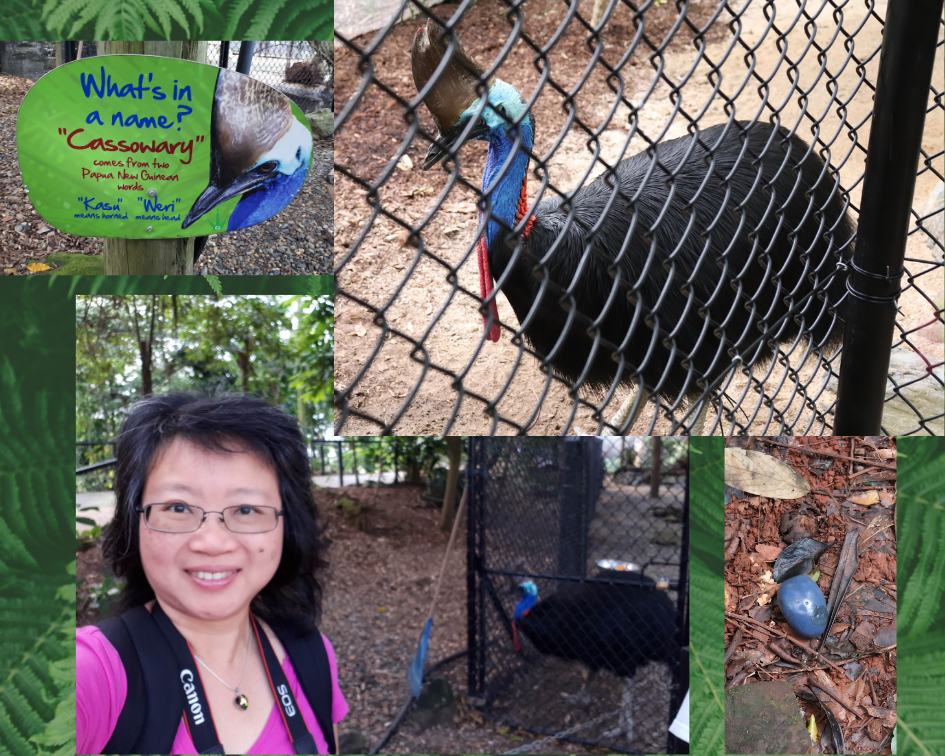


I just met Cass the Cassowary and a Tree Kangaroo!


Have you ever seen a Cassowary? It is a very unique bird that stands eye to eye with a grown man and bears a huge bulbous horn/helmet (casque) on its head.


Southern Cassowary and blue plum Photo copyright Maria Ngo
It can grow up to 200 cm tall. It has a bright blue neck with red wattles on it. Its large body resembles that of an emu (sort of) and it has gigantic sturdy claws on its feet. It has tough bristle-like feathers - which it needs to protect it when it bashes its way through the thick prickly undergrowth of Queensland's rainforests. 

The word ‘cassowary’ name comes from two Papua New Guinean words meaning horned (Kasu) head (Weri).

They can be found in the dense rainforests of Papua New Guinea, parts of Indonesia and the north eastern part of Australia. They tend to be solitary animals and stay in pretty much the same area all year round. 

They eat mostly fruit that fall to the ground as well as other fungi and even snails and small dead mammals. They can eat the poisonous blue cassowary plum which would be quite deadly to humans. It eats it whole and then deposits the large seed with its excrement some distance away – it plays a very important role in the dispersion of the seeds of the blue plum. 

The cassowary can be aggressive if threatened in any way. The breeding season is from June to October. The species is listed as endangered.

If you want to see a Southern Cassowary up close, you can visit Cass who lives in the Port Douglas Wildlife Habitat.

When we were in Port Douglas, we bought multi-visit passes to the centre. We found the tours, feeding sessions as well as educational talks conducted by knowledgeable and passionate keepers most enjoyable and informative.

Tree kangaroo perched in the branches Photo copyright Maria Ngo

Another animal that captured my fancy at the Wildlife Habitat was Lumholtz’s Tree Kangaroo. It is listed as near threatened in Queensland.

The tree kangaroo is a folivore (i.e. leaf eater) but also feeds on fruit. They are nocturnal and tend to sleep hunched in tree canopies in the day time. They have very specially designed fur that point outwards from the middle of their back which allows water to run off their fur. This is very useful when you live in the rain forest which gets a lot of rain (!). 


They are called tree kangaroos because they actually do climb trees! They can go forwards and reverse down as well. They are also quite capable of jumping from a height. They have been observed to jump down 15 metres. 

They tend to be solitary animals and are territorial. Habitat loss as well as falling prey as road kills are threats to their survival.

We returned on two separate occasions to view the animals at different times of the day – this was a bonus as we were able to see the tree kangaroo when it was wide awake and bounding around and also when it was sleeping.

Emu, Tree Kangaroo and Estuarine Crocodile Photo copyright Maria Ngo

There is a large walk through aviary which houses a variety of birds that often wander across your path. You can tell that they are very used to humans visiting them in their home. You can meet many birds, big and small ones, up close here.

More birdsPhoto copyright Maria Ngo

There are other enclosures for mammals and reptiles. The space is divided into different themes: woodland, wetlands, rainforest, savannah and predator plank. You’ve guessed it, it’s Queensland, and the last is the crocodile enclosure. You can walk above the estuarine crocodiles on a plank walkway and get a good view of them.

Kangaroos and more kangaroos Photo copyright Maria Ngo 

And if kangaroos big and small, actively seeking for food, or lounging in the shade, posing for a photo, is your marsupial of fascination, you will be quite the happy camper here.

Cheeky and playful birds Photo copyright Maria Ngo 

So if you want to encounter our Australian icons up close, this is a good place to see them. 


References
Lumholtz's tree-kangaroo. Department of Environment and Science. (https://environment.des.qld.gov.au/wildlife/animals/a-z/lumholtzs-treekangaroo) Accessed: 20.10.2019.

‘Southern Cassowary’ in Australian Museum. (https://australianmuseum.net.au/learn/animals/birds/southern-cassowary/) Accessed: 20.10.2019.


x

Search This Blog